
INFORMED INTERCESSION: Praying for Israel with Eyes Wide Open
Part 2 of 4 | February 24, 2026
Navigation
← Part 1: The Document Every Christian Should Read
Part 3: Why Every Peace Plan Fails →
When “Love Your Enemies” Meets “Death to Israel”: The Impossible Command
The Tension at the Heart of Christian Prayer
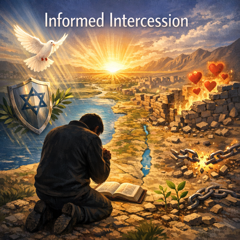
How do you pray for the salvation of those who openly seek the destruction of your friends?
How do you love your enemies when their founding document calls for your obliteration?
These aren’t theoretical questions. They’re the reality for anyone who reads the Hamas Charter and then tries to obey Jesus’ words:
“But I say to you, love your enemies and pray for those who persecute you.” (Matthew 5:44)
When I first read the Charter, I felt the weight of this command in a new way. The words weren’t just political—they were spiritual, and they made loving my enemies feel, frankly, impossible.
What the Hamas Charter Actually Says
The 1988 Hamas Charter is shockingly clear:
- “Israel will exist and will continue to exist until Islam will obliterate it, just as it obliterated others before it.”
- “Jihad is its path and death for the sake of Allah is the loftiest of its wishes.”
- “There is no solution for the Palestinian question except through Jihad.”
- “Peaceful solutions and International conferences are in contradiction to the principles of the Islamic Resistance Movement.”
The 2017 document softens the language but never recognizes Israel’s right to exist. The core message remains: the conflict is religious, the struggle is ongoing, and the call to resistance is unchanged.
Wrestling With an Impossible Command
Jesus’ command to love our enemies isn’t a suggestion—it’s a radical, countercultural call. But what does it look like when the “enemy” is defined by a charter that glorifies martyrdom and calls for your destruction?
The Hamas Charter’s religious justification for violence and its glorification of martyrdom make loving enemies not just difficult, but seemingly impossible. Yet this is precisely where the gospel calls us to stand apart.
A Testimony from the Front Lines (Anonymized for Security)
Recently, a ministry partner serving in sensitive regions shared this with me:
“I have prayed and continue to pray for Israel:
- For the peace of Jerusalem—not only absence of war, but also prosperity (Psalm 122:7)
- For secure borders of Israel—God promised to set Israel’s borders (Exodus 23:31)
- For the release of the hostages (Psalm 138:7)
- For the Jewish people to recognize and accept Jesus as Israel’s Messiah (Matthew 16:16)
- For wisdom for Israel’s leaders (1 Timothy 2:1-2)
- For the Jewish people to be comforted and saved (Isaiah 40:1)
I have read the Hamas Charter with a heavy heart. I was shocked to read that ‘peaceful solutions and International conferences are in contradiction to the principles of the Islamic Resistance Movement’, and that it is ‘a waste of time’. Comparing both documents, I see that Hamas still denies Israel’s right to exist and that there is no alternative to the full liberation of Palestine from the river to the sea.
Now I pray more for Palestinians to be saved, and for restraint of evil (Psalm 35:4 & 33:10).”
This testimony captures the biblical tension: praying for Israel’s protection and prosperity while also interceding for the salvation of those who, by their own words, are enemies.
The Biblical Model: Loving Enemies Without Naivety
Scripture never asks us to ignore evil or pretend threats don’t exist. Instead, it calls us to:
- Pray for protection and justice (Psalm 122:6; Psalm 35:4)
- Pray for the salvation of all people—including enemies (1 Timothy 2:1-4)
- Pray for wisdom for leaders (1 Timothy 2:1-2)
- Pray for the restraint of evil (Psalm 33:10)
Loving our enemies doesn’t mean excusing their actions. It means praying for their transformation, even as we pray for the safety and flourishing of those they threaten.
Practical Guidance: How to Pray When It Feels Impossible
1. Name the Tension in Prayer
Acknowledge before God the difficulty of loving those who seek harm. Honesty is the starting point for transformation.
2. Pray for Israel’s Protection and Peace
Ask God to guard Israel’s borders, protect her people, and grant wisdom to her leaders.
3. Pray for the Salvation of Enemies
Intercede for the hearts of those in Hamas and other groups to be softened, for the gospel to break through, and for true peace to come through Christ.
4. Pray for the Restraint of Evil
Ask God to frustrate the plans of those who seek destruction and to bring justice and righteousness.
5. Pray for the Church to Be a Light
Ask God to empower believers in the region to model Christ’s love, even in the face of hatred.
Actionable Prayer Points for This Week
- Pray Psalm 122:6 for the peace of Jerusalem.
- Pray Exodus 23:31 for secure borders for Israel.
- Pray Psalm 138:7 for the release of hostages and protection from danger.
- Pray Matthew 16:16 for Jewish people to recognize Jesus as Messiah.
- Pray 1 Timothy 2:1-2 for wisdom for Israel’s leaders.
- Pray Isaiah 40:1 for comfort and salvation for the Jewish people.
- Pray Psalm 35:4 and 33:10 for the restraint of evil and the salvation of Palestinians—including those in Hamas.
Multiplying Informed Intercession
As a Ministry Partnership Coach, I train and equip 24 International Representatives across 9 countries to lead their own partners in this kind of informed, gospel-centered prayer. The testimony above is just one example of how reading the Hamas Charter can move us from generic prayers to specific, biblically grounded intercession.
Informed intercession means praying for both the protection of Israel and the transformation of her enemies—because the gospel is big enough for both.
What’s Next in This Series
Part 3 (March 10):
Why Every Peace Plan Fails: Understanding the 2017 “Softening” That Wasn’t
We’ll compare the 1988 Charter with the 2017 document, analyze why peace negotiations collapse, and explore the spiritual barriers to lasting peace.
Part 4 (March 24):
From Conviction to Action: When Knowledge Becomes Responsibility
Subscribe & Download Resources
- Subscribe to the full series: go.www.coach.wlbusch.com/coach-william
- Download the Hamas Charter (1988 & 2017):
1988 Charter PDF
2017 Charter PDF
Father, give us the courage to pray for those who seek harm, the wisdom to intercede for Israel’s protection, and the faith to believe that even the hardest hearts can be transformed by Your love. Help us to love as You love, and to pray as Jesus taught us—even when it feels impossible. In His name, Amen.
The command to love our enemies is not a call to naivety, but to radical, informed intercession—praying for both protection and transformation, even when the world says it can’t be done.